“Take it one day at a time.” We heard that advice from almost everyone we met after our daughter, Kirsty, was diagnosed with a brain tumour. Unlike the herbal remedies, prayers and stories of Great Aunt Maude’s miraculous recovery, this was good advice. Naturally, we ignored it
The other wisdom Maude might have given us is "Count your blessings". And guess what? We’ve discovered the power of self-administered combination therapy. Just like the medical type, it doesn’t always work. But it’s the best we’ve got. To count your blessings in public is to risk sounding smug, complacent, or both, but we’ll do it anyway. By most measures, we’re extraordinarily lucky. Kate and I have three funny, beautiful daughters. Kate’s boss is sympathetic; mine is a tyrant, but as I’m self-employed, I can tell him where to go! Where we once holidayed abroad, we now travel – almost – as happily in the UK. We live close to a great local hospital and within reach of the world leading Royal Marsden. Kirsty is at school, there by virtue of the test she passed just as her eyesight was failing.
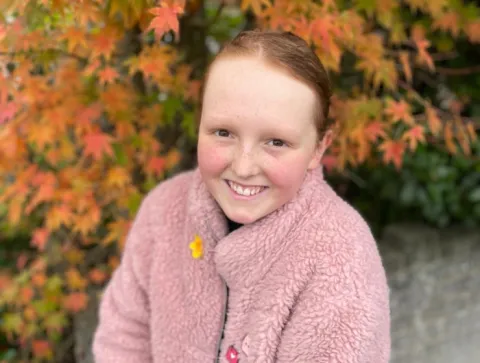
This smart, feisty, creative girl will be home later, moaning about homework. I wish every parent of a child with a brain tumour could say the same. But here’s the other version. Kirsty’s tumour is large and inoperable. The drugs available to her haven’t changed in 50 years. Any growth of her benign tumour could impact her vision and hormones, just as it did before. Unlike last time, when minor shrinkage brought her eyesight back, this might be permanent. Even typing that makes me feel sick. It’s the reality, but who benefits when we turn it over and over in our heads? We choose the first version. And we look for any way we can to boost our blessings.
Kirsty’s determination to help others
After Kirsty’s eyesight came back in spring 2025, we wanted to repay the help that we’d received. Kate and I chose a sponsored cycle, while Kirsty chose crochet. In six months, Kirsty raised £120,000 for Children with Cancer UK. Every day brought life-enhancing moments for Kirsty and us, from the support from our community and the UK’s crochet army, to the thrill of meeting celebrities and attending events. But, by November 2025, Kirsty’s chemo was no longer working. Times like that require you to confront reality. We considered the poor options available. By January, Kirsty was on a new, stronger treatment. By February, we’d got the hang of it. So, at that point, we thought, "Could we capture lightning twice?" and raise some more money. One big problem was that we’d run out of donors. Unconcerned by practicalities, Kirsty suggested: "Let's find all the people called Kirsty and ask them!” A lot of late-night tinkering with ChatGPT later, we were ready to try and mynameiskirsty.com was born. This time, Kirsty wanted to fundraise for research into better, kinder treatments. She chose OSCAR’s Paediatric Brain Tumour Charity. They’re 250 miles from us in York, but very close in their understanding of families like ours. We’ve now found nearly 14,000 people called Kirsty or Kirstie across 53 countries and all seven continents (hello, Antarctica!), with 2,000 Friends of Kirsty also joining her interactive map. She’s raised over £100,000 and has been interviewed worldwide. Does she feel lucky? In many ways she does, and so do we.
What has worked for us
Our approach to Kirsty’s illness is a bit like mindfulness. Anyone who’s tried it will know it’s about ‘noticing and returning’. When our thoughts take us somewhere dark, perhaps as we sign into hospital or after a call, we try to ‘notice and return’. We cushion the blows for Kirsty, now 12, and guide her back. That way, hopefully none of us will hit rock bottom.