Introduction
The tool is based on “A guideline to assist healthcare professionals in the assessment of children and young people who may have a soft tissue sarcoma”. The guideline has been developed following careful consideration of the available evidence, through a systematic review and has incorporated professional expertise via a Delphi consensus process. You can also access the full guideline and summary guideline here.
Click on the symptoms below to navigate individual sections of the guideline and our recommendation to either Refer/Review/Reassure.
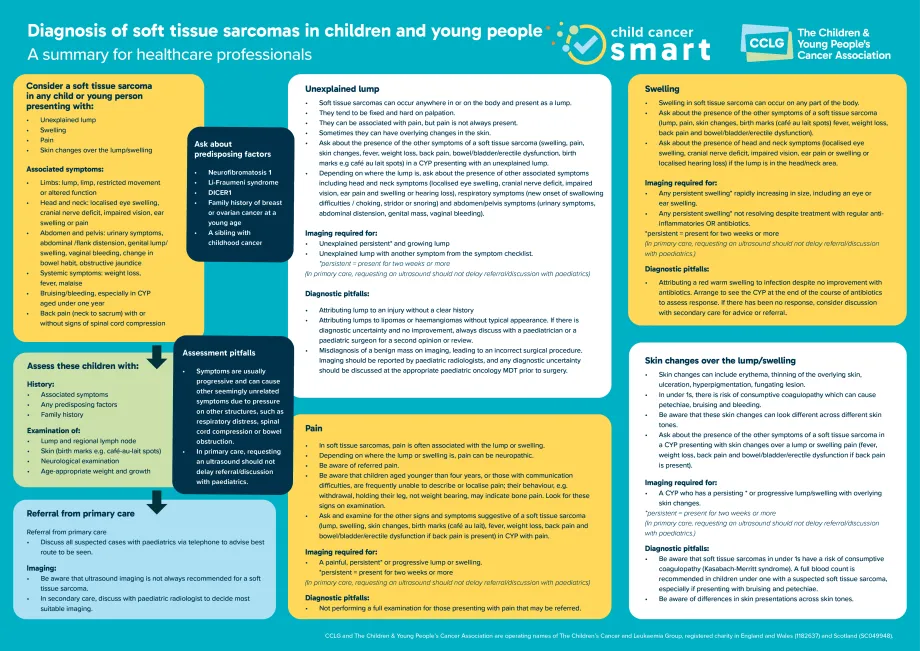
Core and associated symptoms
Soft tissue sarcomas can occur anywhere in the body, and signs and symptoms can differ depending on where the sarcoma originates.
Soft tissue sarcoma symptoms can be grouped into limb, thoracic, head and neck and abdomen and pelvis.
The following signs and symptoms are all associated with soft tissue sarcomas in children and young people aged 0-18 years. Their presence should alert the clinician to this possibility.
Core symptoms
- Unexplained lump
- Swelling
- Pain
- Skin changes over the lump/swelling
Associated symptoms*
- Limbs: lump, limp, restricted movement or altered function
- Head and neck: localised eye swelling, cranial nerve deficit, impaired vision, ear swelling or pain
- Abdomen and pelvis: urinary symptoms, abdominal /flank distension, genital lump/swelling, vaginal bleeding, change in bowel habit, obstructive jaundice
- Systemic symptoms: weight loss, fever, malaise
- Bruising/bleeding, especially in CYP aged under one year old
- Back pain (neck to sacrum) with or without signs of spinal cord compression
*Associated symptoms are dependent on the type and location of the tumour and it is important to ask for the presence or absence of the associated symptoms.
Whilst these associated symptoms were not individually as common, they were all symptoms that in combination with the core symptoms, should warrant thought about soft tissue sarcomas.
Predisposing factors
Ask about common predisposing factors associated with an increased risk of soft tissue sarcoma in children and young people, as this may lower the threshold for investigation:
- Neurofibromatosis 1
- Li-Fraumeni syndrome
- DICER1
- Family history of breast or ovarian cancer at a young age
- A sibling with childhood cancer
1. Unexplained lump
- Soft tissue sarcomas can occur anywhere in or on the body and present as a lump.
- They tend to be fixed and hard on palpation.
- They can be associated with pain, but pain is not always present.
- Sometimes they can have overlying changes in the skin.
- Ask about the presence of the other symptoms of a soft tissue sarcoma (swelling, pain, skin changes, fever, weight loss, back pain, bowel/bladder/erectile dysfunction, birth marks e.g café au lait spots) in a CYP presenting with an unexplained lump.
- Depending on where the lump is, ask about the presence of other associated symptoms including head and neck symptoms (localised eye swelling, cranial nerve deficit, impaired vision, ear pain and swelling or hearing loss), respiratory symptoms (new onset of swallowing difficulties / choking, stridor or snoring) and abdomen/pelvis symptoms (urinary symptoms, abdominal distension, genital mass, vaginal bleeding).
This tool works best on desktop, or by rotating your phone to horizontal
| Symptoms | Actions | |
| Reassure | -- |
|
| Review |
|
|
Refer
|
*persistent = present for 2 weeks or more |
|
- Attributing lump to an injury without a clear history
- Attributing lumps to lipomas or haemangiomas without typical appearance. If there is diagnostic uncertainty and no improvement, always discuss with a paediatrician or a paediatric surgeon for a second opinion or review.
- Misdiagnosis of a benign mass on imaging, leading to an incorrect surgical procedure. Imaging should be reported by paediatric radiologists, and any diagnostic uncertainty should be discussed at the appropriate paediatric oncology MDT prior to surgery.
History
Take a detailed history, including the presence or absence of the other symptoms on the list above, history of injury, predisposing factors and a family history for any CYP presenting with symptoms suggestive of a soft tissue tumour.
Examination
Examination will be guided by where the lump is but should include:
- Examination of the lump/swelling including measurements
- Regional lymph node assessment
- Examination of the skin (birth marks e.g. café au lait spots)
- Neurological examination
Assessment pitfalls
- Symptoms are usually progressive and can cause other seemingly unrelated symptoms due to pressure on other structures, such as respiratory distress, spinal cord compression or bowel obstruction.
- Be aware that if symptoms or clinical suspicion persists despite normal initial imaging, a discussion with the radiologist about the most appropriate repeat imaging is advised.
- Be aware that abdominal masses can cause neurological symptoms due to pressure on the spinal cord. The pressure can cause children to present as “off legs” or refusal to weight bear. Examine the abdomen and spine when a CYP presents with refusal to weight bear.
- Neurological deficit
- Associated respiratory distress
- Diffuse facial swelling/congestion
2. Swelling
- Swelling in soft tissue sarcoma can occur on any part of the body
- Ask about the presence of the other symptoms of a soft tissue sarcoma (lump, pain, skin changes, birth marks (café au lait spots) fever, weight loss, back pain and bowel/bladder/erectile dysfunction)
- Ask about the presence of head and neck symptoms (localised eye swelling, cranial nerve deficit, impaired vision, ear pain or swelling or localised hearing loss) if the lump is in the head/neck area
This tool works best on desktop, or by rotating your phone to horizontal
| Symptoms | Actions | |
| Reassure |
|
|
| Review |
|
|
| Refer |
*persistent = present for 2 weeks or more |
|
Attributing a red warm swelling to infection despite no improvement with antibiotics. Arrange to see the CYP at the end of the course of antibiotics to assess response. If there has been no response, consider discussion with secondary care for advice or referral.
History
Take a detailed history, including the presence or absence of the other symptoms on the list above, history of injury, predisposing factors and a family history for CYP presenting with symptoms suggestive of a soft tissue tumour.
- Determine the exact duration of the swelling and characteristics of the swelling
- Determine any preceding mechanism of injury or bite/scratch
- Ask specifically for associated symptoms, predisposing risk factors and family history
Examination
Examination will be guided by where the swelling is but should include:
- Examination of swelling – determine size and appearance
- Regional lymph node assessment
- Skin examination (birth marks e.g. café au lait spots)
- Neurological examination
- Symptoms are usually progressive and can cause other seemingly unrelated symptoms due to pressure on other structures, such as respiratory distress, spinal cord compression or bowel obstruction.
- Be aware that if symptoms or clinical suspicion persists despite normal initial imaging, a discussion with the radiologist about the most appropriate repeat imaging is advised.
- Swelling that is rapidly increasing in size
- Eye or face swelling
- Features of spinal cord compression
3. Pain
- In soft tissue sarcomas, pain is often associated with the lump or swelling.
- Depending on where the lump or swelling is, pain can be neuropathic.
- Be aware of referred pain.
- Be aware that children aged younger than 4 years, or those with communication difficulties, are frequently unable to describe or localise pain; their behaviour e.g. withdrawal, holding their leg, not weight bearing may indicate bone pain. Look for these signs on examination.
- Ask and examine for the other signs and symptoms suggestive of a soft tissue sarcoma (lump, swelling, skin changes, birth marks (café au lait), fever, weight loss, back pain and bowel/bladder/erectile dysfunction if back pain is present) in CYP with pain.
This tool works best on desktop, or by rotating your phone to horizontal
| Symptoms | Actions | |
| Reassure |
|
|
| Review |
|
|
| Refer |
*persistent = present for 2 weeks or more |
|
Not performing a full examination for those presenting with pain that may be referred pain.
History
Take a detailed history, including the presence or absence of the other symptoms on the list above, predisposing factors and a family history for CYP presenting with symptoms suggestive of a soft tissue sarcoma.
Assessment
Examination will be guided by where the associated swelling/lump is, as well as the pain but should include:
- Examination of lump or swelling – determine size and appearance
- Regional lymph node assessment.
- Skin examination (birth marks e.g. café au lait spots)
- Neurological examination.
- Neuropathic pain
- Pain in spine or pelvis
- Associated neurological deficit
4. Skin changes over the lump/swelling
- Soft tissue sarcomas can present with overlying skin changes which can be interpreted as infection and be a distracting feature.
- Skin changes can include erythema, thinning of the overlying skin, ulceration, hyperpigmentation, fungating lesion.
- In under oness, there is risk of consumptive coagulopathy which can cause petechiae, bruising and bleeding.
- Be aware that these skin changes can look different across different skin tones.
- Ask about the presence of the other symptoms of a soft tissue sarcoma in a CYP presenting with skin changes over a lump or swelling pain (fever, weight loss, back pain and bowel/bladder/erectile dysfunction if back pain is present).
This tool works best on desktop, or by rotating your phone to horizontal
| Symptoms | Actions | |
| Reassure |
|
|
| Review |
|
|
| Refer |
|
|
- Be aware that soft tissue sarcomas in under ones have a risk of consumptive coagulopathy (Kasabach-Merrit syndrome). A full blood count is recommended in children under one with a suspected soft tissue sarcoma, especially if presenting with bruising and petechiae.
- Be aware of differences in skin presentations across skin tones.
History
Take a detailed history, including the presence or absence of the other symptoms on the list above, predisposing factors and a family history for CYP presenting with symptoms suggestive of a soft tissue sarcoma
Assessment
- Examination of skin (birth marks e.g. café au lait spots)
- Examination of the lump/swelling
- Regional lymph node assessment
- Neurological examination
- Fungating/ulcerating lesion
- Signs of coagulopathy in an infant
One-page summary