Introduction
The tool is based on the 'A guideline to assist healthcare professionals in the assessment of children and young people who may have a bone tumour'. The guideline has been developed following careful consideration of the available evidence through a systematic review and has incorporated professional expertise via a Delphi consensus process. You can also access the full guideline, and a summary version will be produced shortly.
Click on the symptoms below to navigate individual sections of the guideline and our recommendation to either Refer/Review/Reassure.
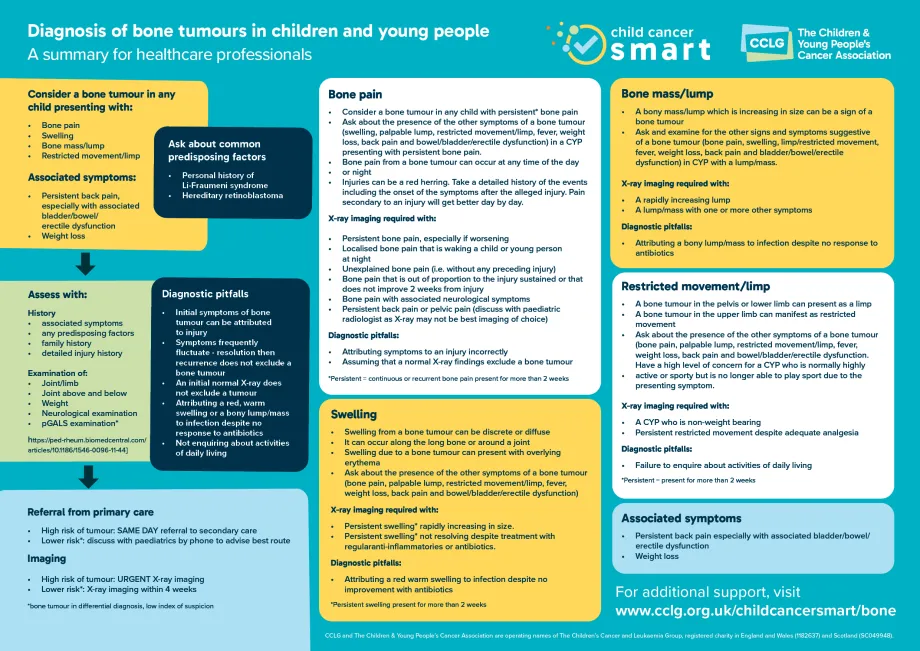
Core and associated symptoms
The following symptoms and signs are all associated with childhood bone tumours. Their presence should alert the clinician to this possibility.
Core symptoms
- Bone pain
- Swelling
- Bone mass/lump
- Limp/Restricted movement
Associated symptoms
- Persistent back pain especially with associated bladder/bowel/erectile dysfunction
- Fever
- Weight loss
Symptoms and signs in childhood bone tumours may occur singularly or in combination.
1. Bone pain
- Consider a bone tumour in any child with persistent* bone pain
- Ask about the presence of the other symptoms of a bone tumour (swelling, palpable lump, restricted movement/limp, fever, weight loss, back pain and bowel/bladder/erectile dysfunction) in a CYP presenting with persistent bone pain.
- Bone pain from a bone tumour can occur at any time of the day or night
- Injuries can be a red herring. Take a detailed history of the events including the onset of the symptoms after the alleged injury. Pain secondary to an injury will get better day by day.
- Bone pain can also be a symptom of leukaemia. Consider a full blood count and film in CYP where there are additional symptoms of fatigue, pallor, bruising or bleeding.
*Persistent = continuous or recurrent bone pain present on most days for 2 weeks or more
This tool works best on desktop, or by rotating your phone to horizontal
| Symptoms | Actions | |
| Reassure |
| Reassure |
| Review |
|
|
| Refer (and consider imaging) |
|
|
- Attributing symptoms to an injury incorrectly – when there is a vague or only suspected history
- Assuming that a normal X-ray findings exclude a bone tumour, especially for back or pelvic pain and when symptoms are still persisting
- Joint/limb examination: look, feel, move, assess
- Neurological examination
- pGALS examination
- Pain in spine or pelvis
- Affecting activities of daily living
- Associated neurological deficit
2. Swelling
- Swelling from a bone tumour can be discrete or diffuse
- It can occur along the long bone or around a joint
- Swelling due to a bone tumour can present with overlying erythema
- Ask about the presence of the other symptoms of a bone tumour (bone pain, palpable lump, restricted movement/limp, fever, weight loss, back pain and bowel/bladder/erectile dysfunction)
This tool works best on desktop, or by rotating your phone to horizontal
| Symptoms | Actions | |
| Reassure |
|
|
| Review |
|
|
| Refer (and consider imaging) |
*Persistent swelling present for more than 2 weeks |
|
- Attributing a red warm swelling to infection despite no improvement with antibiotics
- Determine the exact duration of the swelling and characteristics of the swelling
- Determine any preceding mechanism of injury or bite/scratch
- Ask specifically for associated symptoms and risk factors: personal history of Li Fraumeni syndrome or hereditary retinoblastoma
- Joint/limb examination: look, feel, move, assess
- Neurological examination
- pGALS examination
- Swelling that is rapidly increasing in size
3. Bone mass/lump
- A bony mass/lump which is increasing in size can be a sign of a bone tumour
- Ask and examine for the other signs and symptoms suggestive of a bone tumour (bone pain, swelling, limp/restricted movement, fever, weight loss, back pain and bladder/bowel/erectile dysfunction) in CYP with a lump/mass
This tool works best on desktop, or by rotating your phone to horizontal
| Symptoms | Actions | |
| Reassure |
| |
| Review |
|
|
| Refer (and consider imaging) |
|
|
- Attributing a bony lump/mass to infection despite no response to antibiotics
- Assuming that bony lump has been present since birth and unnoticed by parents/carers prior to presentation
- Determine the exact duration and size of the lump/mass
- Determine any preceding mechanism of injury
- Ask specifically for associated symptoms and risk factors: personal history of Li Fraumeni syndrome or hereditary retinoblastoma
- Joint/limb examination: look, feel, move, assess
- Neurological examination
- pGALS examination
- With associated neurological deficit
4. Restricted movement/limp
- A bone tumour in the pelvis or lower limb can present as a limp
- A bone tumour in the upper limb can manifest as restricted movement
- Ask about the presence of the other symptoms of a bone tumour (bone pain, palpable lump, restricted movement/limp, fever, weight loss, back pain and bowel/bladder/erectile dysfunction)
- Have a high level of concern for a CYP who is normally highly active or sporty but is no longer able to play sport due to the presenting symptom
- Follow your local limping child pathway
This tool works best on desktop, or by rotating your phone to horizontal
| Symptoms | Actions | |
| Reassure |
|
|
| Review |
|
|
| Refer (and consider imaging) |
*Persistent = present for more than 2 weeks |
|
- Failure to enquire about activities of daily living
- Be aware that abdominal masses can cause neurological symptoms due to pressure on the spinal cord. The pressure can cause children to present as “off legs” or refusal to weight bear. Examine the abdomen and spine when a CYP presents with refusal to weight bear.
- Determine the exact duration of the limp/ restricted movement
- Determine any preceding mechanism of injury
- Ask specifically for associated symptoms and risk factors: personal history of Li Fraumeni syndrome or hereditary retinoblastoma
- Joint/limb examination: look, feel, move, assess
- Neurological examination
- pGALS examination
- Associated neurological deficit
- Previously high-level athlete, unable to continue
Summary poster