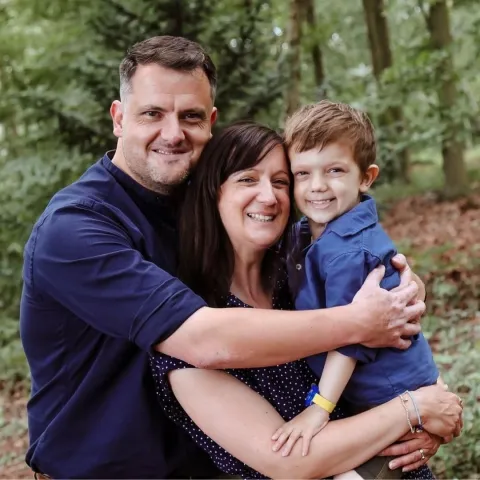
This Childhood Cancer Awareness Month, we spoke to Lisa about George's story and how being involved with CCLG's PPI Group has given her a sense of purpose while becoming an important part of her healing journey.
Could you tell us a little bit about George and how he was diagnosed?
George was diagnosed at age three with high-risk rhabdomyosarcoma. George was a healthy, happy little boy, and there were no signs or symptoms before a lump appeared. George woke up one morning and he had a lump at the side of his head in the temple location, and we immediately thought perhaps he'd bumped it, and we decided we needed to seek medical advice and find out what was going on.
Did George’s diagnosis take a long time?
Getting George's lump diagnosis cancer didn't take an awful long time because what followed were further symptoms. However, just presenting a very healthy, happy little boy who wanted to run around the doctor's surgery and play with the toys, it was quite challenging to be taken seriously. To begin with, I was told it was an infection and he'd need some Calpol.
He then fell asleep in the car on the way back past nine in the morning, and I knew that wasn't George who would normally be running around. And so, I decided to get a second opinion. And at that point the doctor googled lumps to the head, cysts to the head, and showed me some images and told me he thought it was a cyst and we were sent away bank holiday weekend and told to call 111 if any further symptoms developed.
And I think luckily for George, over that weekend he spiked temperature and he began to get some earache, which enabled us to make that call and to eventually get seen by an emergency GP. And then from that point on, we were quite quickly sped through A&E and investigations took place.
Did you know much about childhood cancer then?
Before George was diagnosed, we knew nothing about childhood cancer. I have spent a career working in schools and had supported a family whose son had leukaemia, but I knew nothing. I had no idea that a lump, particularly on the head, on the side of the face, that that would ever be cancer, maybe naively, didn't even consider. That's what it would be. So, the work that CCLG: The Children and Young People's Cancer Association are doing around raising awareness for signs of symptoms is really important.
How did you find out about CCLG?
To begin with, we had been advised to look for information about rhabdomyosarcoma on the CCLG website. So, from the beginning we were aware of the charity and the support they gave and the really useful information for families. That led us to find out a bit more about the charity.
The first thing we decided to do was to set up the Special Named Fund. We set up Just George actually months before George passed. So, he was part of building our logo, and he understood that we were raising money for the scientists to help make his good cells stronger and for children in the future.
What was it about George’s experience that made you want to get involved with research?
What became really clear when George passed is that with him being our only child, that it was going to be really important for us to find purpose in this kind of new version of our life.
And that's where, having met one of the other parent and public involvement group members, another parent who also had a special name fund, I met with them and discussed how they get involved and was really keen to think that I might be able to play a small part in research into childhood cancer. George loved science, he loved learning, and he was really curious.
And I just knew that working with research would give me some purpose. And I also knew that George would be really proud that we were helping children in the future and learning more.
Why are parents’ voices important for research?
As time went on, it became really clear that embedding lived experience into research is important, and through time began to realise that parents and carers are in a really unique position.
They see childhood cancer away from a clinical setting. They see it at bedtime, at bath time, at school, a children's parties, going to the beach. Parents and carers are used to delivering treatment to their young people away from that clinical setting. In my mind, it's really important that we embed lived experience into research. So, I decided to see if I could get involved.
How can this make a difference?
We know that the Children and Young People's Cancer Association are working really hard to close the gap between those cancers that have good outcomes and poorer outcomes, find kinder treatments for children and more effective treatments. And I think the Patient and Public Involvement (PPI) group can really help think about when a new drug is being discussed: How would that be administered? How would that work for a family at home? How would that work for a young person who perhaps is able to go back to school and maybe wants to go and play on the beach? Is that something that would be straightforward? Would there be challenges and complications?
And I think in order to really think about kinder and more effective treatments, we've got to think about the impact on the family as a whole, with those treatments that are being delivered outside of that clinical setting. And I think that is where the voice of parents and the public who have lived experience can really add to research.
What is it like advising on research as a parent?
To begin with, I was a bit concerned - I don't have a science background. I was a bit worried there'd be terminology that I didn't understand, but actually that's not what it's about. What it's about is really thinking about how important this research is. Would this research have been something that was important to us as a family?
And actually, you are guided through the process so gently. There are people in that group who've done it for a number of years who are quite experienced, who can offer support. We're a good group to kind of work together and to say, I have no idea what that word means, or can someone tell me what that acronym is?
But it's much more about think about your lived experience and consider this research how this would have impacted you as a family.
Do you have any messages for other people with lived experience who might want to get involved?
My message to other parents or survivors of childhood cancer who are perhaps thinking about getting involved is to reach out. There are other parents, other survivors, who would be able to talk to you about what we do.
I think, until you've been in a meeting and been part of those conversations, it's hard to understand the impact you could have. And I know, you would be really welcome to come and see what it looks like and be part of some of those conversations. But come and ask the questions - don't think it's not for you, because it certainly is.
What impact does getting involved have for you?
Personally, it's about giving me some purpose, and I think it's been a really important part of my healing process. I just want to learn more. I just want to understand it better. Childhood cancer isn't going anywhere, and I would love to think that my involvement somewhere down the line can have impacted children and young people in the future.