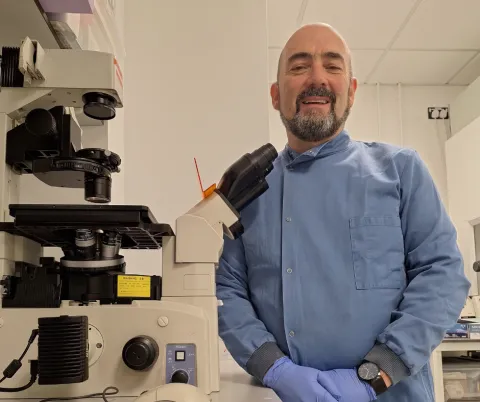
PROJECT TITLE: Twin-based models for more effective treatment of childhood leukaemia
LEAD INVESTIGATOR: Professor Alex Thompson
INSTITUTION: University of Nottingham
AWARD: Approx. £95,000 (funded by The Little Princess Trust/administered by CCLG)
Although significant advances in the treatment of childhood leukaemia have been made over the last two decades, patients are often left with long-term health problems. Many of these problems are due to side-effects of the current drugs that couldn’t be picked up when the drugs were being designed, developed and tested. These side effects damage or kill normal cells in the patient as well as the leukaemia cells. The goal of childhood leukaemia research is now to protect normal cells while still killing the cancer. This means that, as researchers, we need new ways to compare healthy cells and leukaemia cells, ensuring that any new treatments are less toxic to children.
Our research
Our study involves making blood cells in the laboratory that we can engineer to be genetically identical, as in twins, except for the key cancer-causing mutation. In this way, normal blood cells will be produced beside childhood leukaemia blood cells, which will allow us to examine current and new experimental drugs side by side. This direct comparison in genetically identical cells, apart from the mutation, will allow us to rule out drugs that damage or kill the normal cells while identifying those that are specific for the leukaemia.
To achieve this, Dr Sasha Kondrashov will use a protein that acts like a pair of microscopic scissors to cut the DNA in a specific type of normal stem cell that can generate all the different cells of the body. The DNA cut will be specific to the position of the mutation seen in childhood leukaemia. Once the cut has been made, he will paste in a DNA sequence that will allow for the production of the cancer-causing mutation. A second or more round of selection will be used to generate the genetically identical leukaemia equivalent twin to the normal stem cells. Work’s already well under way to create the twin stem cell lines. These stem cells are very fragile and will need to be grown for several months to make sure they're strong enough to be made into normal or leukaemia blood cells.
Once the set of twin stem cells have been generated, Sasha will grow them in specific nutrients and growth factors to promote their ability to make blood cells. The specific type of normal blood cells being made are equivalent to those that are often damaged during current leukaemia treatment and are therefore a good ‘model’ to look at side effects. Once established, Sasha will use the twin-based normal and leukaemia blood cells to look at the effect of current leukaemia drugs and compare these to experimental drugs being developed in the laboratory or around the world.
Proof that the drugs work against the leukaemia cells will be determined by several methods including reduced cell growth, increased cell death and loss of leukaemia ability. Proof that the drugs don’t work against the normal cells will be determined by normal cell growth, lack of cell death and retention of normal stem cell ability. Drugs that are effective against the leukaemia but keep the normal blood cells alive will be selected for future clinical trial. Using this method, we aim to find kinder drugs for childhood leukaemia.
From Contact magazine issue 111 | Summer 2026