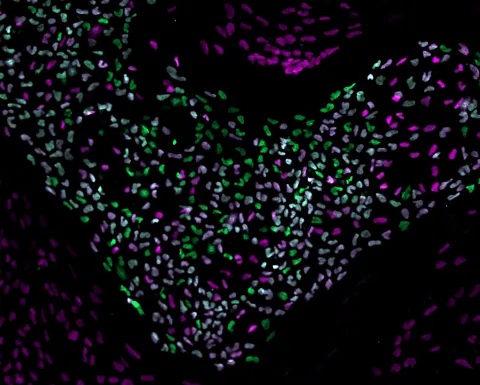
Image of cells in lab

Developmental origins of paediatric cancer symposium

A one-day event showcasing the latest cutting-edge research on the modelling, biology and treatment of paediatric cancers in the context of their developmental origins.

A one-day event showcasing the latest cutting-edge research on the modelling, biology and treatment of paediatric cancers in the context of their developmental origins.

The aim of the meeting is to bring together researchers at the interface of stem cell, developmental and cancer biology with translational and clinical researchers in order to foster exchange of ideas, collaborations and networking opportunities.

Major themes include:

  • Development of novel in vitro and in vivo models of paediatric cancers and insights gained from their use
  • Risk factors/genetic drivers
  • Tumour dependencies and implications for therapy

Further information about the symposium

09:55 Welcome


Chairs: Karen Liu/Sally George

10:00-10:30 Florian Halbritter, CCRI, Vienna: Modelling paediatric tumour development – human pluripotent stem cell approaches

10:30-10.45 Natalie Andersson, Lund/Sanger: Clonal Bottlenecks in Normal and Predisposed Paediatric Liver Development

10.45-11.00 Caleb Reagor, Rockefeller University/Karolinska Institutet: Self-Supervised Learning Uncovers a Shared Mesenchymal Landscape across Development and Cancer

11.00-11.15 Lena Kutscher, Heidelberg: Developmental Determinants of Male Bias in Group 3/4 Medulloblastoma

11.15-11.45 Majlinda Lako, Newcastle University: Modelling paediatric tumour development –human pluripotent stem cell approaches

11:45-12 Flash talks:

  • Thomas Eckhardt, St. Anna Children's Cancer Research Institute: A New Human Stem Cell-Derived Sympathoadrenal Linegae Organoid Model to Study Neuroblastoma Initiation
  • Charlie Jones, University of Edinburgh: Dismantling cPRC1 Complexes to Inform Targeting of Diffuse Midline Glioma
  • Isabella Scott, ICR: Targeting Chromatin Remodelers in MYCN-amplified Neuroblastoma 
  • Justas Stanislovas, UCL: Osteosarcoma Cells Undergo Transient Cell Cycle Arrest and Transcriptional Rewiring which Enable their Survival in Response to Map Chemotherapy in vitro

12:15-13.30 Lunch and posters


Chair: Anestis Tsakiridis

13:30-14.00 Steve Pollard, University of Edinburgh: Tumour dependencies and implications for therapy

14:00-14.15 Sumana Shrestha – UCL/ICR: Mapping the MYCN-driven Oncogenic Transformation of Neuroepithelial Stem Cells to Embryonal Tumour with Multilayered Rosettes (ETMR)

14.15-14.30 Harry Leitch, UCL GOS: On the Developmental Origins of Paediatric Germ Cell Tumours

14:30-15.00 Katrin Ottersbach, University of Edinburgh: Modelling paediatric tumour development –in vivo models


15:00 Coffee break/posters


Chair: Deb Tweddle

15:30-16:00 Ruth Palmer, University of Gothenburg: Tumour dependencies and implications for therapy

16:00-16.15 Irina Poverennaya, Medical University Vienna: RNA Modifications Connect Fate Selection in Neural Crest and Prognosis in Neuroblastoma

16:15-16.30 Jessica Taylor, Cambridge: FOXO3 Suppression Underlies Subtype Diversity in WNT-Medulloblastoma

16:30-17.00 Chris Jones, ICR: Risk factors and drivers of paediatric tumours


17:00-18.00: Prize announcements/ Drinks reception and posters

Book your place today

We gratefully acknowledge the support of:

Neuroblastoma UK

Share your research: call for abstracts

We welcome abstracts on basic, translation and clinical research on the symposium theme of 'developmental origins of paediatric cancer'. There will be an award for best oral presentation and best poster. This is a fantastic opportunity to showcase your work to the research community. All abstracts will be scored based on the criteria objective/background, method, results, conclusion relevance and impact. 

Abstract submissions now open
Deadline: Extended to Midnight, 20 March 2026

If you would like to submit an abstract to be considered for oral or poster presentation, please submit an abstract online using our grant management system, FlexiGrant. If you have not used this system before, you will need to register a new account.

Abstract submission information

All abstracts will be scored based on the following criteria:

  • Objective/Background
  • Method
  • Results
  • Conclusion, impact and relevance
  • Applicants must be able to attend the CCLG Developmental Origins of Paediatric Cancer Symposium (8 June 2026 in London) and will be expected to register at the prevailing conference fee once notification of acceptance for oral or poster presentation has been given
  • If submitting for poster presentation, applicants must be able to provide their work in printed poster format (specifications to be provided) for display during the Annual Conference.
  • The applicant must be the first or last author and presenting author of the submitted abstract

Please note: if your abstract is accepted, it is expected that you register for the conference at your own expense (early bird discounts will be available).

  • Each abstract will undergo a review process by the judging panel
  • Acceptance will be based on the achieved abstract scores and final decision will be made by a review panel consisting of the organising committee as well as external research review panel members
  • The successful candidates will be notified in April if their abstract has been accepted for presentation
  • No correspondence on the judges’ decision can be initiated by the author(s)
  • Use the standard headings 'Introduction/background', 'Methods', 'Results', 'Conclusions/Implications' to construct your abstract
  • Type your abstract in English using Word
  • Maximum 500 words – does not include title, author list or references
  • Include a title, author list and affiliations
  • Your abstract should fit on one side of A4
  • You can enter more than one abstract
  • Submission of an abstract acknowledges your acceptance for the abstract to be published in any official conference publications eg. conference app, member website
  • The presenting author is required to ensure that all co-authors are aware of the content of the abstract and agree to its submission before submitting the abstract

Deadline extended: The deadline for receipt of abstracts is now 20 March 2026 at midnight

Abstracts should be submitted online via FlexiGrant and we will acknowledge receipt of your application. You will need to create an online account on FlexiGrant and follow the instructions. Drafts can be saved on the system until you complete the submission.

Please make sure your submission is showing as completed on our online system by the deadline as we cannot accept any draft applications.

Submit an abstract